 Gilding
Arts Studio
Gilding
Arts Studio "Opening the Eyes"
SACRED COLOURS
Buddhist Art for the 21st Century
Vajrapāni
Gilt finished in Platinum, 23 karat Red Gold, 18 karat Green Gold, also Fine Gold and Palladium. Turquoise and Coral gemstones represent the jewellery typically worn by the bodhisattva. Formed in copper repoussé, with the hands cast from wax models.
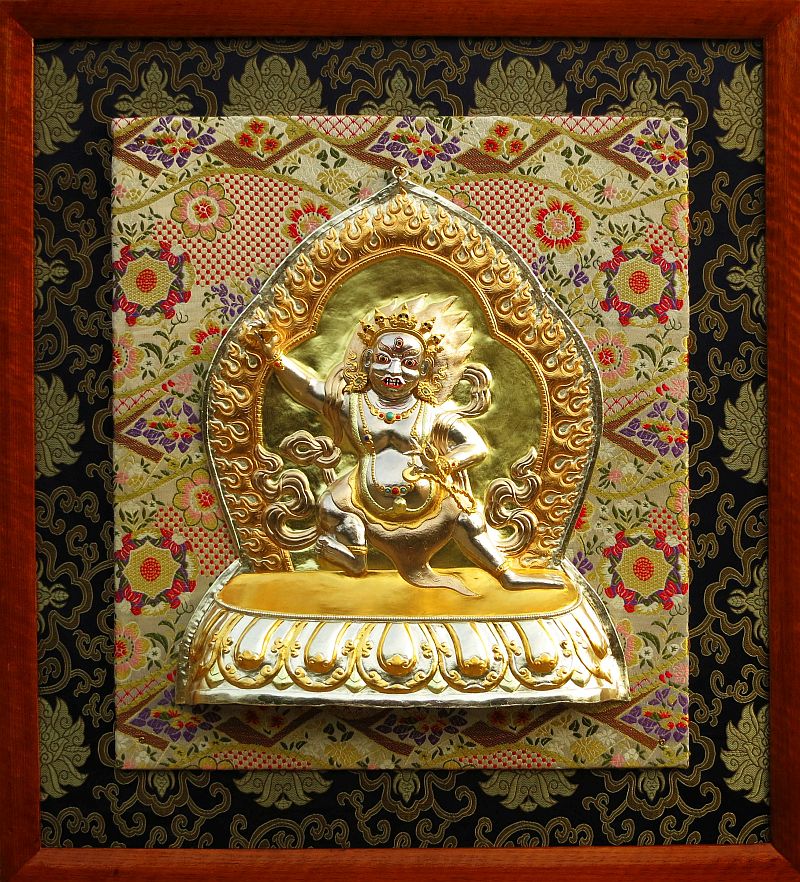
This
hand-fabricated copper repoussé sculpture is from the workshop of Chaitya Raj
Shakya in Patan, Nepal, with the finishing work, gilding and opening of the eyes
from Martin Walker-Watson’s Gilding Arts Studio. Platinum leaf and a variety of
colours of gold leaf were laid to produce the gilt finish. It is set with
turquoise, coral and lapis lazuli gemstones. The hands of the mudra are cast
from wax. The sculpture is mounted on brocade and framed – 63 x 69 cms.
Vajrapāni is
extensively represented in Buddhist iconography as one of the three protective
deities surrounding the Buddha; Mañjuśrī manifests all the Buddhas' wisdom,
Avalokiteśvara manifests all the Buddhas' compassion and Vajrapāni manifests all
the Buddhas' power.
Vajrapāni is
mentioned in the Pāli Canon, worshiped in the Shaolin Monastery as the patron
saint, and in Tibetan Buddhism and Pure Land Buddhism as a Bodhisattva.
Manifestations of Vajrapāni can also be found in many Buddhist temples in Japan
as Dharma protectors. However, the earliest representations of Vajrapāni are
from the 2ndcentury in the Hellenistic influenced art of Gandhara
that portray him as Hercules. As the wielder of the thunderbolt he is often
associated with the Vedic thunder-god Indra but also with Zeus and Jupiter.
Vajrapāni's image
contains several key elements: Vajrapāni's expression is wrathful to generate
fear in the individual to shake-up one’s dogmatic attitude. The asana or yogic
posture is the warrior pose (pratyālīḍha). His loin cloth is made up of the skin
of a tiger (which in ancient times showed his fearlessness) and his outstretched
right hand brandishes a vajra, a thunderbolt, symbolizing analytical knowledge
that dissolves craving, attachment and delusion. His left hand holds a lasso
with which he binds negative thoughts and emotions. Around his neck is a serpent
necklace (as a potent guardian) and he wears a skull crown
representing the
five main afflictions of anger, greed, pride, envy and ignorance, which are
conquered and transmuted into the five wisdoms - ultimate reality,
discriminating, equalizing, all-accomplishing, and mirror wisdoms. He has a
third eye.
Vajrapāni does not
to many newcomers to Buddhism look very Buddhist at all, yet he is a Bodhisattva
who represents the energy of the enlightened mind completely free of hatred and
anger. Those seeing Vajrapāni for the first time may wonder how such a
wrathful-looking figure could possibly fit with the peaceful associations they
may have with Buddhism, although such figures are actually quite common in the
Mahayana and Vajrayana traditions. Of course it’s not possible to adequately
represent the qualities of Enlightenment in any image, and so even the peaceful
forms of Buddhas and Bodhisattvas are to some extent misleading. Enlightened
beings do not, in reality, sit around all day on lotuses smiling serenely. The
Buddha himself was fearlessly active in engaging with the other religious
figures and philosophers of his day.
Although Vajrapāni
is described as “wrathful” it’s important to realize that this does not
represent ordinary anger, but simply the power and fearlessness of the awakened
mind. There is no place in Buddhist practice for “righteous anger,” and despite
his appearance Vajrapāni is a profoundly compassionate figure.
This sculpture is
one of a kind and unique. It is currently part of my private collection.
Commissioning another similar piece will inevitably be slightly different.
Om Vajrapāni Hum


for more repoussé - click here
© thegilder 2017 - all rights reserved